A while ago, I stumbled across a new workflow for learning complex topics that has transformed how I self-study.
The Problem: Consuming != Remembering
I love listening to audiobooks and podcasts, especially about history. Right now, I’m working through Our Oriental Heritage, the first volume of Will Durant’s monumental The Story of Civilization. It’s a sweeping introduction to the ancient world before the rise of Greece, covering Sumer, Egypt, India, China, and beyond.
Unfortunately, I don’t have a photographic (audiographic?) memory. After finishing a chapter, the vivid scenes and interconnections inevitably dissolve into vague impressions. While listening to history is certainly entertaining in its own right, without intervention what remains from these epic stories is little more than a faint echo. This is a problem - not just for trivia night, but for building a connected understanding of the past. Luckily, cognitive science has had a solution to this problem for a very long time.
The Forgetting Curve and the Power of Spaced Repetition
Back in 1885, psychologist Hermann Ebbinghaus described a phenomenon now known as the forgetting curve. It shows how our brains discard new information over time - unless we deliberately review it.
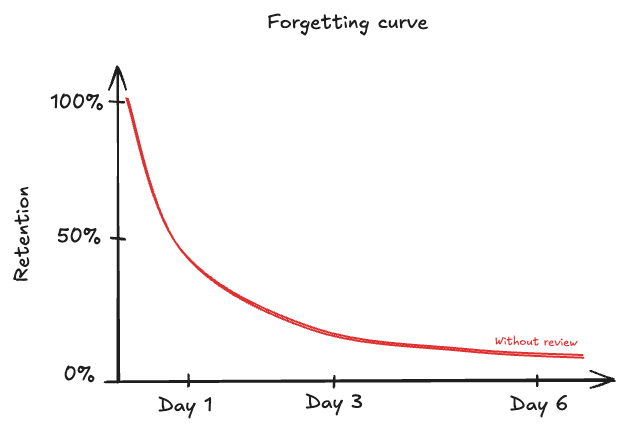
Enter spaced repetition: this learning technique (think flashcards!) combats forgetting by prompting you to recall information at increasing intervals (e.g., after 1 day, then 2 days, then 4, 8, 16…).
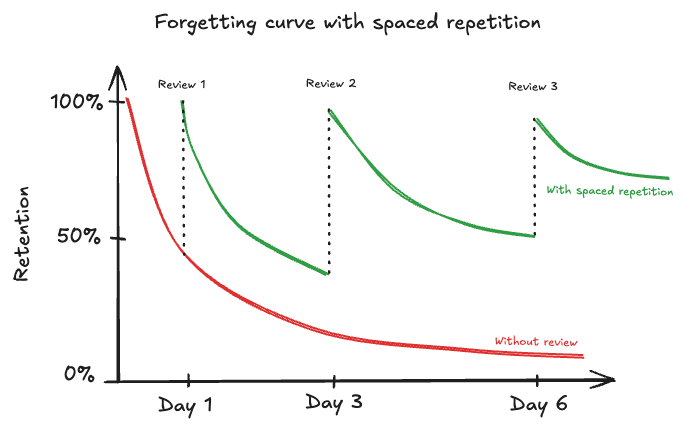
The scientific evidence for the efficacy of spaced repetition is overwhelming. If you don’t want to take my word for it, Gwern’s essay on spaced repetition is an outstanding, well-sourced overview. What’s so powerful about this technique is that with repeated reviews, the memory becomes stronger and the effort required to commit a new piece of information to memory levels off asymptotically - eventually the required refresh interval for a piece of knowledge becomes years. Gwern did the math:
If, over your lifetime, you will spend more than 5 minutes looking something up or will lose more than 5 minutes as a result of not knowing something, then it’s worthwhile to memorize it with spaced repetition.
The Tools That Make This Possible
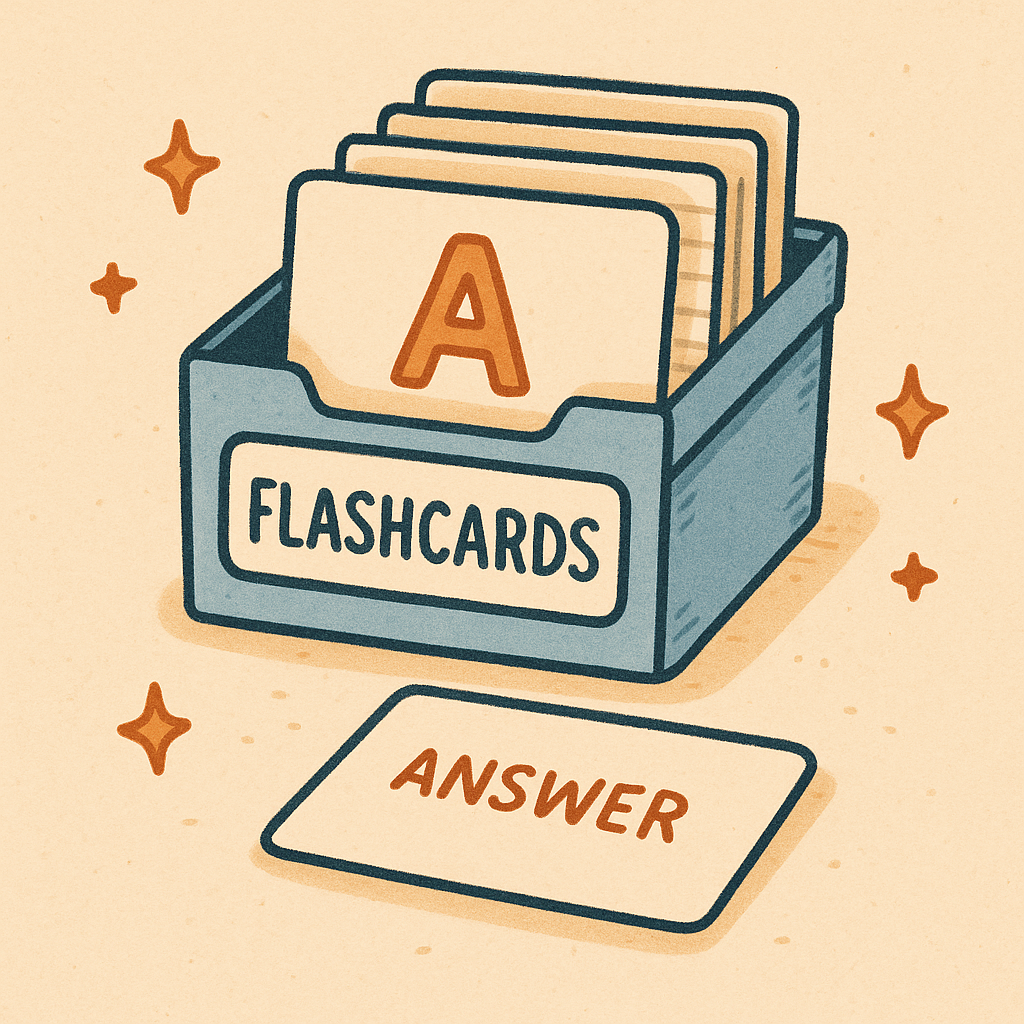 In the past, people would undergo a lot of effort to write flashcards on physical paper, which they'd study and then manually reschedule for future review. This sounds tedious, not fun at all, and I totally get why spaced repetition hasn't already taken over the world of education.
However, technology has advanced and it is finally time to reap the rewards of a century-old idea. My current system is powered by a few carefully chosen digital tools that work together nicely:
- Anki: The gold standard in spaced repetition flashcard software. It’s beloved by med students, language learners, and anyone who needs to retain large volumes of detailed knowledge.
- Obsidian: An ultra-customizable, markdown-based notetaking app. Because each note is just a text file underneath, it’s highly portable, future-proof, and easy to back up, making Obsidian a great choice for a lifelong personal knowledge vault.
- Obsidian_to_Anki: An Obsidian plugin that syncs flashcards written in Obsidian directly to Anki. Although development has stalled, I’ve started working on my own fork to revive it.
- Any to-do app: Used to quickly capture “future flashcards” as they occur to me - more on this below.
- GitHub (optional): I store my entire knowledge vault as a repository on GitHub. This isn’t necessary (especially for folks unfamiliar with git), but it gives me the peace of mind of having a secure, cloud-backed, and trackable archive of everything I’ve learned.
How it all fits together
1. Consume High-Quality Audio Content
Like many of us, I’ve been spicing up my commute, workouts, and chores by listening to tons of audiobooks and podcasts for years. My high score on Spotify Wrapped was 14,000 minutes of podcasts one year. This is great to build basic familiarity with a topic’s overarching narrative and its principal actors, but isn’t enough to commit the information to long-term memory.
2. Capture Keywords as Prompts
So whenever something strikes me as worth remembering for the rest of my life, I just note down a quick keyword into my “To Ankify” todo-list (e.g., “Persepolis,” “Darius defeat at Marathon,” or “Tiamat the chaos goddess”). I usually don’t even hit pause on the listening, so this is super low-friction, but it gives me an actionable list of prompts for further study to follow up on later.
3. Dedicated Ankification Sessions
When I have focused time (usually 60–90 minutes, often first thing in the morning on a Saturday), I sit down for what I call an ankification session. I just pick items from the bottom of my list and do a quick round of research.
Because some time has passed from creating that note (seriously, what is “north attacking south” even supposed to mean?!), I’ll usually use Perplexity to generate a short summary of the topic to kickstart the process. I don’t recommend blindly trusting AI output, indeed I fact-check everything using more trusted sources (my faves are Wikipedia and Britannica). However, Perplexity is impressively accurate most of the time and can be prompted to explain itself in even simpler terms if I’m struggling to understand something on a very high level. While online encyclopedias are factually accurate, they also tend to be really verbose, so this is super useful to get a first understanding of a topic.
After a few rounds of back-and-forth with the AI, I will attempt to extract the essence of what I’ve learned and compress it into a single sentence, which I then put into my Obsidian note on the topic e.g.:
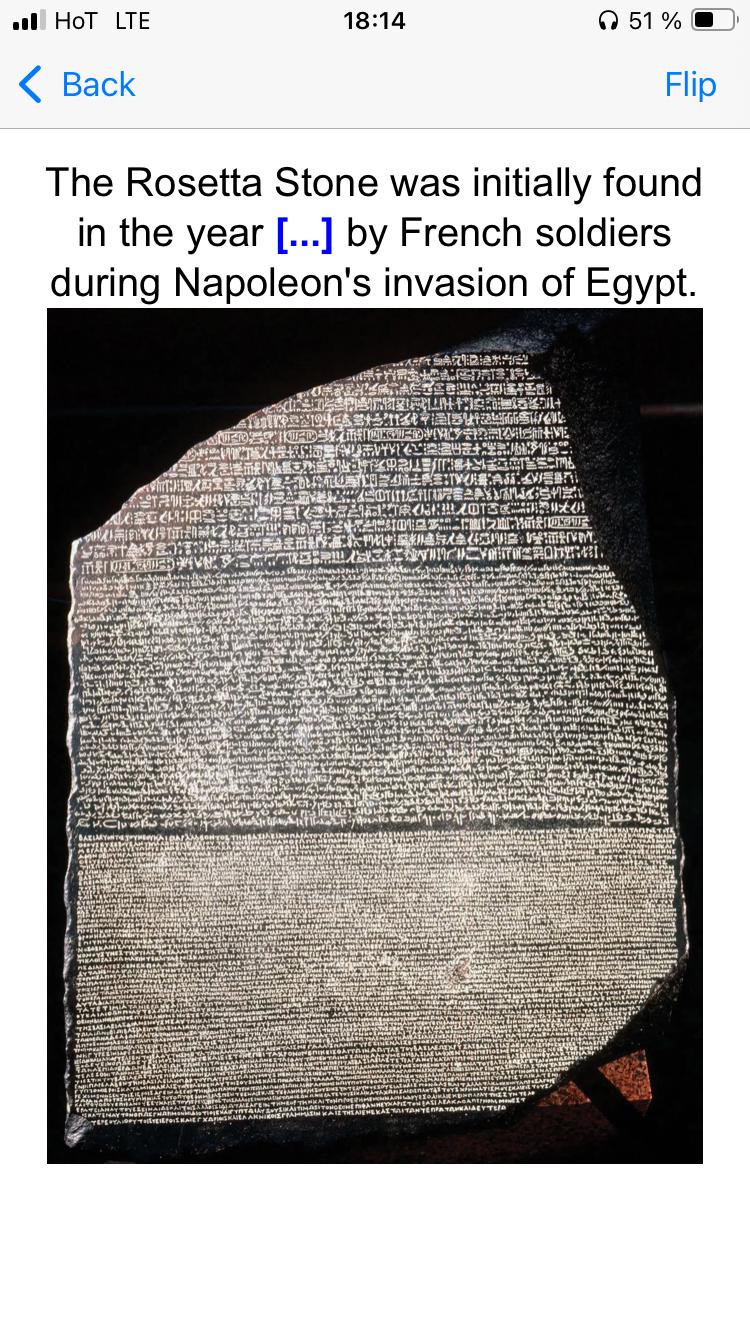
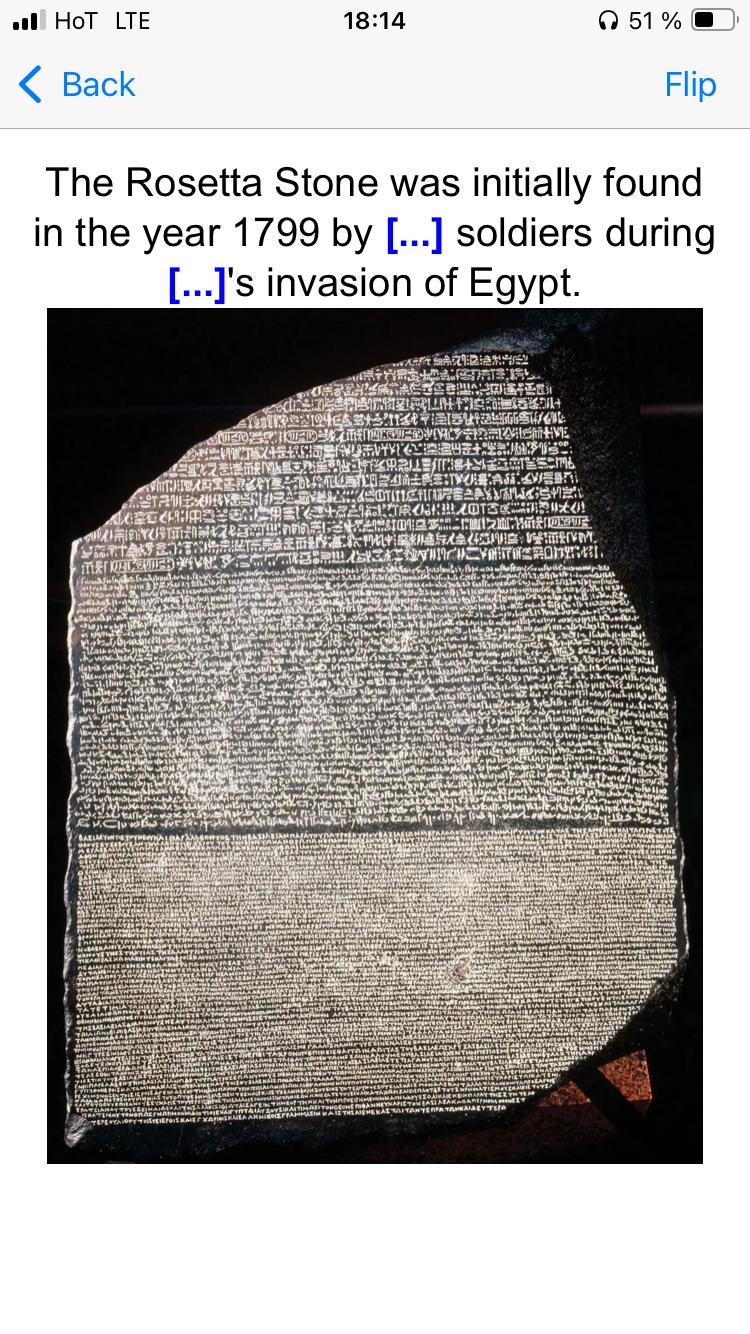
The Rosetta Stone was initially found in the year 1799 by French soldiers during Napoleon’s invasion of Egypt.
would go into ancient-egypt.md.
So far so good. We’ve all taken notes on topics, only to never look at them again and forget everything you worked so hard for. This is where the magic of the Obsidian_to_Anki plugin enters.
4. Ankify your notes with Obsidian_to_Anki
This delightful (and sadly currently abandoned) piece of software connects your Obsidian knowledge vault with Anki (via Anki Connect) and allows you to create Anki flashcards directly from your nicely formatted markdown files.
To achieve this, I blank out the forgettable information (a learning technique called cloze deletion or occlusion) in my “essence sentences”, following this simple syntax:
The {c1:Rosetta} Stone was initially found in the year {c2:1799} by {c3:French} soldiers during {c3:Napoleon}'s invasion of Egypt.
Upon clicking the “Sync to Anki” button, Obsidian_to_Anki will detect the curly brackets and create three separate Anki flashcards:
How cool is this?! By simply taking notes on a subject, doing some research (which I'd do anyway) and sprinkling over some extra syntax, I am now guaranteed to remember this basically for the rest of my life (as long as I regularly review my cards ¯\_(ツ)_/¯).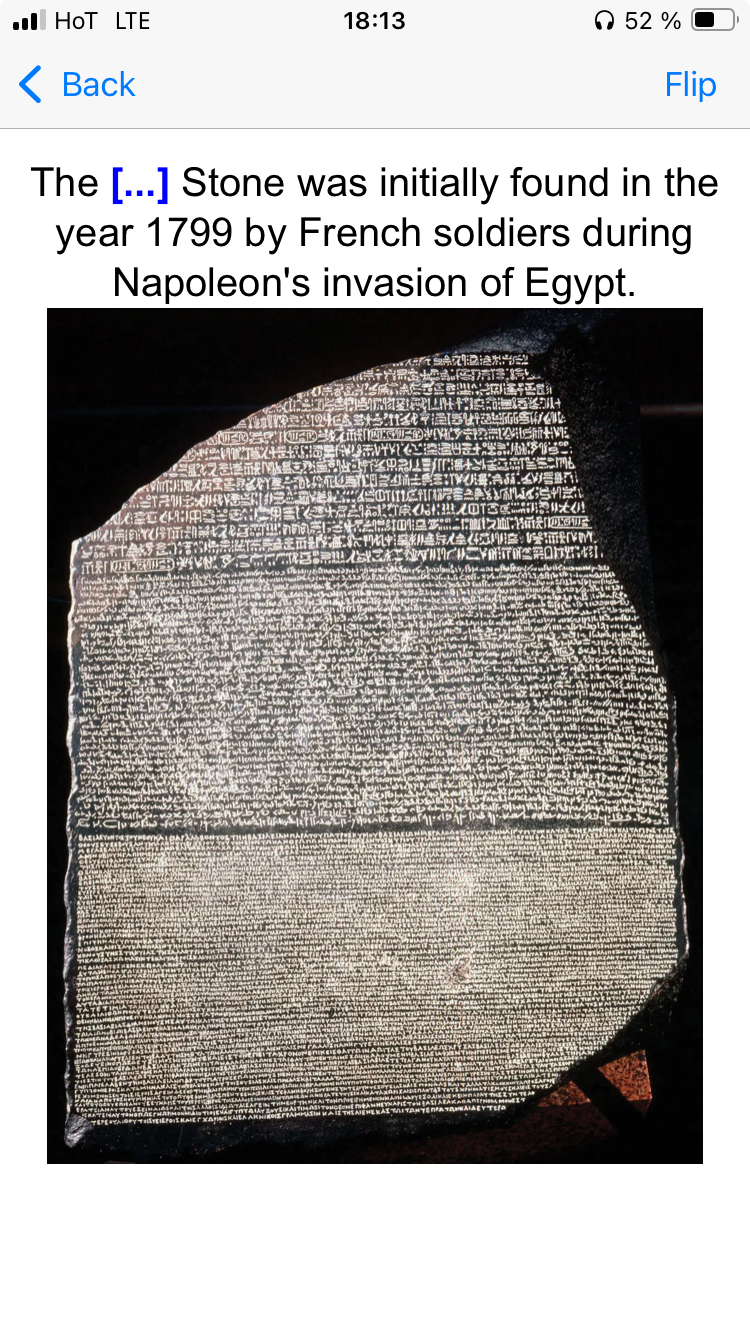
The absolute cherry-on-top is that the Obsidian_to_Anki plugin attaches the flashcard ID, which enables future updates to existing cards from markdown.
The {c1:Rosetta} Stone was initially found in the year {c2:1799} by {c3:French} soldiers during {c3:Napoleon}'s invasion of Egypt.
So instead of having to painstakingly create flashcards in Anki’s rather clumsy native card editor (which isn’t a lot of fun!), I now get to maintain a collection of high-quality research notes that are fun to read and write, and which just happen to resolve into flashcards at the click of a button!
Final Thoughts
This workflow has utterly transformed my relationship with learning. Instead of putting in the effort and yet feeling like history is slipping through my fingers, learning now feels like I’m building a personal, permanent mental library, one flashcard at a time.
It’s not instant. It’s not magic. Of course you still need to put in the effort to actually acquire the information, ankify notes and review flashcards. But it turns well-intentioned but futile efforts into steady, cumulative progress, which really adds up over the years.
If you’re into self-education, history, or just want to retain more of what you consume, I can’t recommend spaced repetition enough. Paired with tools like Anki and Obsidian, it becomes a powerful way to remember what you learn.